
In the decentralized world of blockchain, there is no central bank or “Big Boss” to verify transactions. When you send cryptocurrency to someone, how does the network know you actually have those funds and haven’t already spent them elsewhere? This is where consensus mechanisms come in—they are the engine that allows a distributed network of computers to agree on a single version of the truth without a central authority .
Think of it as the rulebook for a game. Everyone must follow the same rules for the game to work fairly. These rules prevent double-spending and ensure the integrity of the entire system . The two most dominant rulebooks are Proof-of-Work (PoW) and Proof-of-Stake (PoS) . But which one is “better”? Let’s break down how they work, their key trade-offs, and why the answer depends entirely on what a blockchain aims to achieve.
What is Proof-of-Work (PoW)? The Original Standard
Proof-of-Work is the original consensus mechanism, created by Satoshi Nakamoto for Bitcoin. It relies on computational work to secure the network. In a PoW system, participants called miners compete to solve complex cryptographic puzzles using powerful, specialized hardware .
How It Works
Miners race to be the first to find a valid hash for a new block of transactions. This process is like a massive guessing game—miners make countless calculations per second until one finds the winning number . The first miner to solve the puzzle gets to add the block to the blockchain and receives a reward in the network’s native cryptocurrency .
Key Advantages of PoW
- Proven Security: PoW has a long track record of over a decade, proving its reliability and resilience. Bitcoin, the most valuable cryptocurrency, uses PoW and has never been successfully hacked .
- High Decentralization: In theory, anyone with mining hardware can participate and contribute to network security . The low barrier to entry for running a node is seen as a key democratic feature .
- Costly Attacks: Executing a 51% attack—where a bad actor gains control of more than half the network’s computing power—is astronomically expensive, requiring vast amounts of electricity and hardware .
Major Drawbacks of PoW
- High Energy Consumption: This is PoW’s most famous criticism. Miners run high-powered hardware 24/7, consuming enormous amounts of electricity .
- Centralization of Mining Pools: While theoretically decentralized, mining has become dominated by large pools and industrial-scale farms that can afford the huge operational costs, creating centralization risks .
- Slower Transaction Speeds: Compared to PoS, PoW networks generally have lower transaction throughput and higher latency .
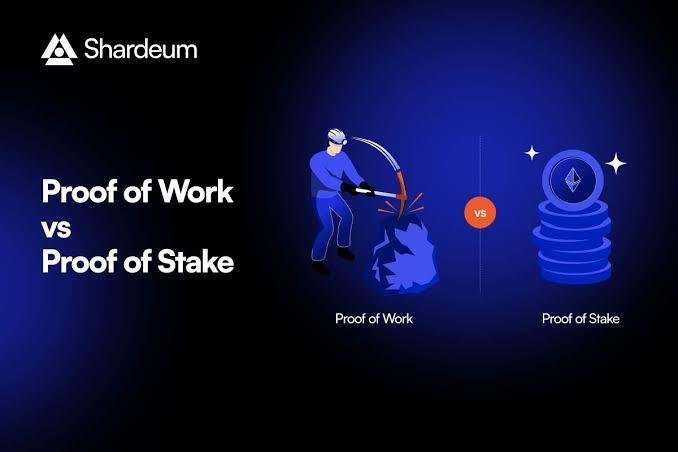
What is Proof-of-Stake (PoS)? The Energy-Efficient Evolution
Proof-of-Stake was introduced in 2011 as a more sustainable alternative to PoW. It completely eliminates the need for energy-intensive mining . Instead, the network is secured by participants called validators who lock up, or “stake,” a certain amount of cryptocurrency as collateral .
How It Works
The protocol selects validators to propose and attest to new blocks, and the selection is usually weighted by the amount of cryptocurrency they have staked . The more coins you lock up, the higher your chances of being chosen to validate a block and earn rewards. If a validator acts dishonestly or attempts to validate a fraudulent transaction, they can be “slashed” —meaning a portion of their staked cryptocurrency is burned by the protocol .
Key Advantages of PoS
- Dramatically Energy Efficient: PoS consumes a tiny fraction of the energy used by PoW. Ethereum’s switch to PoS (“The Merge”) in September 2022 cut its energy consumption by over 99.9% .
- Lower Barriers to Entry: Validators can often use standard computers with reliable internet connections, rather than expensive, specialized mining rigs . (Though, as with Ethereum, the staking requirement can still be high—32 ETH for a solo validator).
- Faster Transaction Finality: PoS networks generally process transactions more quickly and offer better scalability, leading to higher transaction throughput .
Drawbacks of PoS
- Potential for Wealth Centralization: Critics argue PoS can lead to a “rich get richer” scenario. Validators with larger stakes are more likely to be selected and earn rewards, which they can then restake, potentially concentrating power among the wealthiest participants .
- Less Battle-Tested: PoW is a more mature technology with a proven security model over a much longer timeframe. Newer PoS networks haven’t had the same real-world testing against adversarial threats .
- Complexity: Staking can be technically complex. Users must choose between exchange staking, liquid staking, or running a solo validator node—each with different risk and reward profiles .
Proof-of-Work vs. Proof-of-Stake: A Head-to-Head Comparison
| Feature | Proof-of-Work (PoW) | Proof-of-Stake (PoS) |
|---|---|---|
| Validation Method | Mining (solving complex puzzles) | Staking (locking up cryptocurrency) |
| Energy Consumption | Extremely high | Low |
| Security Model | Secured by computational power | Secured by economic incentives and slashing |
| Hardware | Specialized (ASICs, GPUs) | Standard computer |
| Transaction Speed | Generally slower | Faster |
| Attack Resistance | Requires enormous computing power | Requires controlling a majority of staked currency |
| Examples | Bitcoin, Litecoin, Dogecoin | Ethereum (since 2022), Cardano, Solana |
| Network Finality | Probabilistic (can be reversed) | Often faster and more deterministic |
The “Blockchain Trilemma” Trade-off
When comparing PoW and PoS, it’s essential to understand the Blockchain Trilemma. This is the challenge of balancing three critical aspects of a blockchain network: Security, Decentralization, and Scalability . Most consensus mechanisms sacrifice one to optimize the other two.
- Bitcoin (PoW): Prioritizes security and decentralization. It is incredibly secure and anyone can mine, but this comes at the cost of scalability (slow transaction speeds) and high energy use.
- Ethereum (PoS): Prioritizes security and scalability. The switch to PoS improved transaction speed and massively reduced energy usage. However, some argue it sacrifices some decentralization because of the high (32 ETH) barrier to entry for becoming a solo validator, which can put power in the hands of large staking pools .
So, Is Proof-of-Stake Really Better?
There is no one-size-fits-all answer. PoW and PoS are not “better” or “worse”—they are different tools for different jobs.
Proof-of-Work is the heavyweight champion of security and immutability. It’s the conservative choice, perfect for a network like Bitcoin, whose primary goal is to be a resilient, censorship-resistant store of value, even if that means being slow and energy-intensive .
Proof-of-Stake is the choice for innovation, speed, and sustainability. It’s ideal for modern, application-focused blockchains like Ethereum that need high throughput and smart contract functionality without the crushing environmental cost. The sheer scale of Ethereum’s energy reduction post-Merge—from 58.26 TWh to just 7.87 GWh annually—demonstrates its immense advantage in sustainability .
The future of blockchain will likely see a mix of both. Some networks are even exploring hybrid models that combine PoW’s security with PoS’s efficiency . Ultimately, whether PoS is “better” depends on whether you value decentralization and a proven track record above all else, or if you prioritize efficiency and innovation.
Frequently Asked Questions (FAQs)
1. Is Proof-of-Stake more secure than Proof-of-Work?
It depends on the measure. PoW is a battle-tested system with a 15+ year track record, making it incredibly difficult to attack due to the sheer computing power required . PoS is secure in a different way, using economic penalties (slashing) to disincentivize bad actors. However, newer PoS implementations have a shorter history, which critics see as an unproven security model against sophisticated attacks .
2. Why did Ethereum switch from Proof-of-Work to Proof-of-Stake?
Ethereum made the historic switch (“The Merge”) on September 15, 2022, primarily to drastically reduce its energy consumption and improve scalability. The shift cut Ethereum’s energy use by over 99.9% , making it environmentally sustainable and laying the foundation for future upgrades to increase transaction speed .
3. What is the biggest disadvantage of Proof-of-Stake?
The most common criticism is centralization risk. Because validators are selected based on the amount they stake, wealthier participants have a higher chance of being chosen and earning rewards, which they can then restake. This “rich get richer” dynamic can lead to power and control being concentrated among a small number of large stakeholders or staking pools .
4. How does a 51% attack work differently on PoW and PoS?
- PoW Attack: An attacker must gain control of more than 51% of the network’s computing power (hash rate) . This requires buying or renting millions of dollars worth of hardware and electricity .
- PoS Attack: An attacker must acquire more than 51% of the total staked cryptocurrency . On a large network like Ethereum, this would cost tens of billions of dollars, making it prohibitively expensive. Additionally, the PoS protocol can slash their stake, causing a direct financial loss .
5. Can I stake cryptocurrency without running my own validator node?
Yes, there are several ways. The easiest is exchange staking, where platforms like Binance or Coinbase handle the technical work in exchange for a fee . Another option is liquid staking, where you deposit tokens into a protocol (like Lido or Rocket Pool) and receive a liquid representation of your stake (like stETH) that you can trade or use in other DeFi applications . This allows participation without meeting the high hardware or capital requirements of running a solo node.